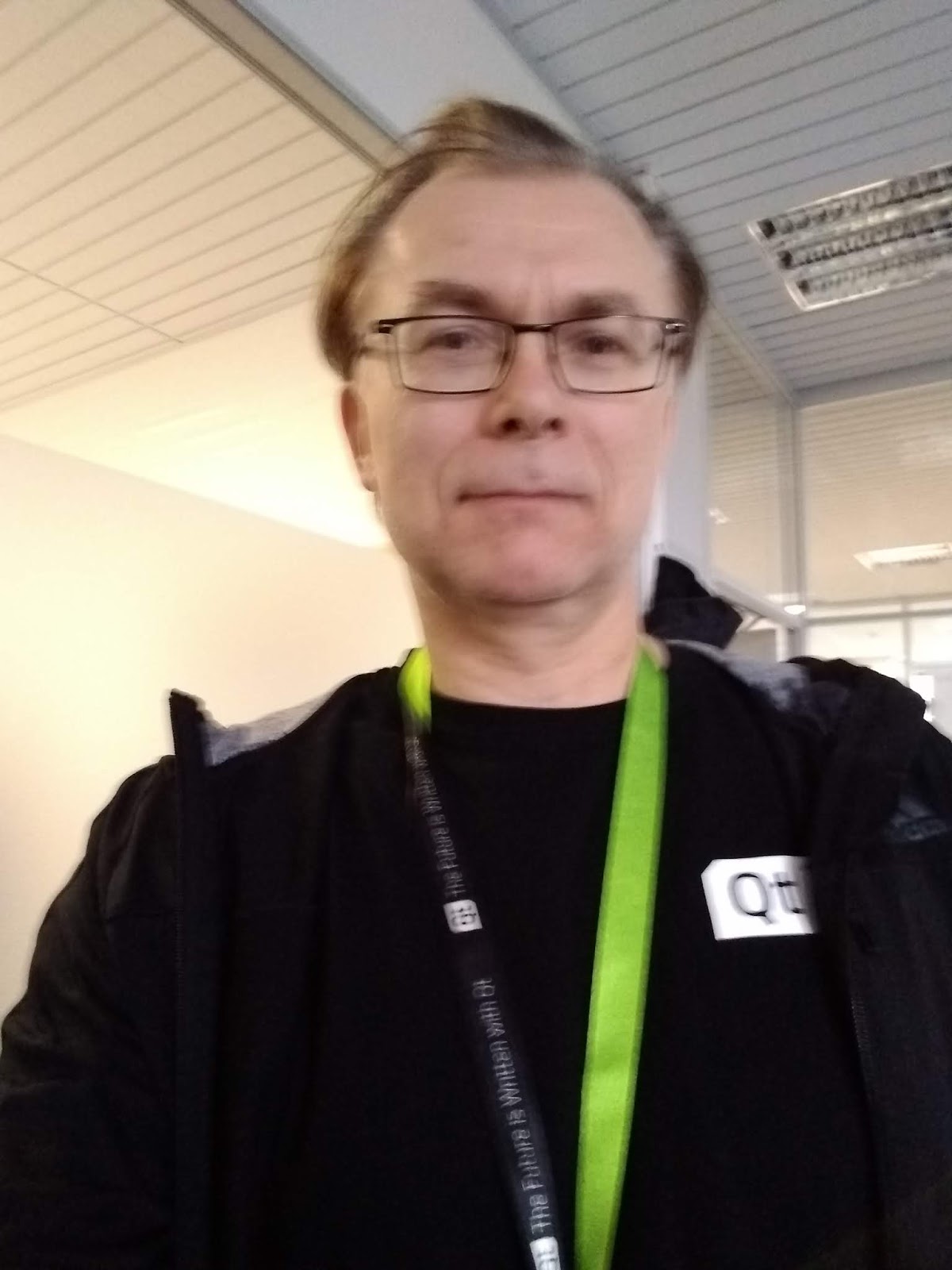
You've probably noticed that I'm not a hell of a conference goer, didn't you? The last conference I attended was the first "Meeting C++" conference in 2014, at that time still taking place in Neuss, Rhineland* instead of the worldly and hipster Berlin.
I tried to go to the two consecutive Meeting C++ conferences in Berlin, but I was both times unable to do it, so eventually I gave up and called it a day on this idea.
But because recently I got somehow more seriously involved with the Qt framework** I thought, hey, why not just go to this one Qt conference*** in Berlin and visit some of my people there as well? No sooner thought than done. And now, three months something later, another idea struck me -
why not write up some impressions? So let us go over things I came to remember most vividly.
Of course you could start moaning that it is
much toooo late for a trip report, but better late than sorry, so let us begin!
1. Lars Knoll's talk
Lars Knoll, the CTO of the Qt Company was giving a talk on general directions for the future Qt 6 development and it was rather interesting. You can check it out
here (PDF), but basically QML will be reworked to be a typed programming language, Javascript will be only optional and graphics will support not only
OpenGL but also newer APIs like
Vulcan,
Metal or
Direct3D 12. All that's very interesting, but what struck me the most was the following slide:
![]()
As it seems
Qt is predominantly used on Windows! That's kind of surprising, taking into account that all the books and articles you read always assume Linux as a platform! I personally did a lot of Qt work on Windows and couldn't ever understand that.
This slide gave me a nice, fuzzy feeling, because my
decision to write my Qt book from a point of view of a Windows developer was a right one!
Other books always describe the tooling you can use on Linux, but this doesn't help me on Windows, because most of that tooling (open source) doesn't exist there. So writing of the
Chapter 2 (Profiling and Profilers) was a kind of a discovery journey - how can I make open source tooling run and correctly work on Windows?
2. Keynotes
As much as I don't like keynotes - normally they are rather full of business-y bla bla - but one slide of the Natalie Nahai's presentation really impressed me, I mean this one:
You can see the change of the vibes of a webpage from the left (boring, lots of distractions, unusable!) to right (cool, clear, using 1-click donation buttons). Nice! And it really happened during Obama's campaign.
3. Caliatys hydrogen mobility talk
This one was also a keynote (or I think so...) but the CTO of the company has shown us the slide containing a decision table they used for choosing the Qt framework as a platform for mobile development. The application in question should run on both iPhone and Android device. After the recent switch of Dropbox away from a commonn C++ codebase for both platforms you would maybe expect that C++ isn't good for mobile.
See their reasons for choosing Qt in the pic below:
The cloud connector had to be written separately for each platform, apart from this Qt provided for platform-independence!
4. QML on Microcontrollers
I already said, that the new QML will be a compiled, statically typed language in Qt 6. Already today, we can have a foretaste of the future with Qt Quick Ultralite (
Qt QUL) that can be run on MCUs (microcontrollers) - a feat in itself, as up to this day Qt and QML needed a much more beefy processors to be run onto! There were quite a few talks centering around that theme, because it seems to be the future of Qt.
Qt Quick Ultralite is thus basically
a subset of QML which can be compiled to C++ and run on bare metal (or an RTOS). This is also a direction in which QML will be going in Qt 6. I was pleasently surprised to learn, that Qt QUL was developed by the Qt Company in cooperation with a polish enterprise that ported it to many MCUs (see the picture below 👇).
As it's my native country, I couldn't help but to be very pleased. Good job Poland! 😍
5. People and stories
As it goes, I stumbled upon 2 of my old clients at the conference! I tool the opportunity and asked them about how my old projects fared after I left. We had quite good chats and I wanted to talk to them on the next day also, but - you won't believe it -
I couldn't spot them anymore! The conference is a pretty big event with masses of people and finding someone is rather matter of luck.
I also could (and was honored to) meet some, i.e. two 🙂, Qt-involved people, I only knew from Twitter, in the real world. As I expected. they turned out to be very nice indeed! Plus I also wound up talking to people in the queue to the canteen and at the exhibitor stands - I even could ask Qt's CTO a question face-to-face after his talk.
Now let us proceed to the
"stories" part of this section:

One of my customers I met at the venue told me a nice story right form the threnches, They had
a beast of a performance problem with the embedded device in my old project (accidentally same project as in the perf. story 6.4 in the book**), namely, after a day being powered on, the device started to slow down up to a total grind - the UI became totally unresponsive and you had to reboot it. What is your guess for the reason of that?
Yes, you are right, a memory leak.
But you'll never guess what couse it! When displaying the time of the day, on every update (i.e. every second) the displayed string was changed and then restyled using CSS styles. As it turned out, there was
a bug in the Qt version we used and restyling leaked memory at that place!
How could you possibly find that?!?!, I asked, quite shocked. Well, it was accomplished by the old and proven method of pinching off parts of the programm until the problem disappears. A kind of
"divide and conquer" of debugging. The solution? Quite a pragmatic one - just don't use styling in the updates. Unfortunaltely, I forgot to ask how's the look and feel of the widget now.
Want another story? Here we go - I met 2 guys in the queue in the canteen and chattet with them for quite a long time. At the evening, I went out with my Berlin people to their favourite craft beer bar in the neighbourhood. After a couple of pints I catched a glimple of some guy at the counter and had to ask myself - do I know that guy? No, impossible, only locals frequent this bar... But after a couple of further glimpses I just had to settle that and chatted up the guy and his friend. Guess what - they were the exact people I met at the conference. Then we had one more chat and I even could pitch my book** to them! Moral - everybody can google, there isn't such a thing like a hidden gem or an insider-only venue. 😔
6. Merchandise

Of course I also got some merchandise:
- a Qt sticker set 📗,
- a T-shirt and a lanyard keychain from Qt 👉,
- sleeping mask (Batman style!) 🦇, also from Qt,
- some small stickers from exhibitor companies
But not that much I'd expect. There was a raffle where you could win a cool drone (sponsored by one of the exhibitors), but this time I was kinda outta luck.
7. Summing up
You tell me - do you think it was a good conference? The main lecture hall was very impressive in any case. An you could see the Berlin TV-tower right out of the window.
---
* early supporter! 🙋
** see this book:
https://www.packtpub.com/application-development/hands-high-performance-programming-qt-5
*** i.e. to the Qt World Summit conference. BTW, here are all QtWS-2019 videos to watch:
https://resources.qt.io/qt-world-summit-2019